
How to Reduce Cleaning Crew Travel Time Between Sites
Travel time silently kills cleaning margins. A practical guide to cutting it with live dispatch maps, proximity-based assignment and a few changes to how you write contracts.
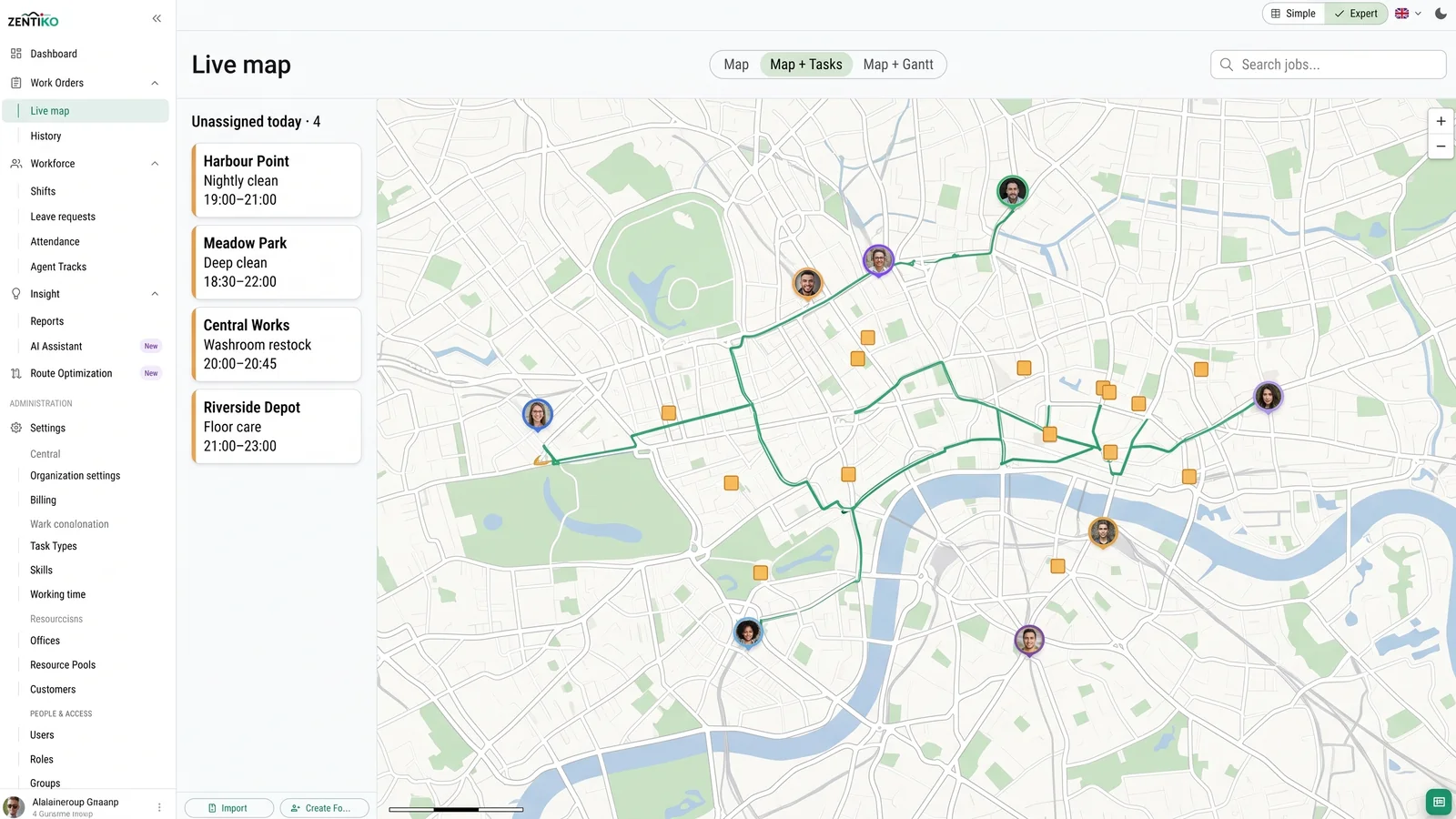
Travel time is the silent margin killer in office and commercial cleaning. The average mid-market cleaning company burns 20–35% of every shift moving between sites — paid hours that produce zero billable output. Cutting that number by even half an hour per crew per night funds a real raise across the team or drops straight to the bottom line. This guide is a practical look at how cleaning operators reduce travel time between sites in 2026 — without buying expensive truck-routing software.
Measure travel first; intuition is wrong
Every operator we talk to dramatically underestimates travel time. The reason: travel is invisible in spreadsheets, which only show start and end times. Once you put crews on a live GPS map with per-task arrival detection, the truth shows up — and it is usually 25–40% of the shift, not the 10–15% the dispatcher believed.
Before optimizing anything, get a real baseline. Track average minutes-between-tasks per crew across two full weeks. That is your starting line.
Assign by proximity, not by familiarity
The single largest source of avoidable travel time is dispatch by familiarity ("Maria always cleans the law firm"). When the dispatcher gives the next job to whoever just finished closest, instead of whoever is most familiar with the building, you usually cut travel by 25%+.
Live dispatch maps make this trivial: the dispatcher sees crews as pins on the map and drags the next task to the closest qualified one. Familiarity loses only a few minutes of onboarding-each-time; proximity wins many minutes of saved travel every night.
Cluster contracts geographically when you sell
A common mistake: chasing every office cleaning account regardless of where it sits. The smarter move is to look at your service map and prefer to sign contracts in zones where you already have crews and contracts. Each new account in an existing cluster is dramatically more profitable than an isolated one because travel scales sub-linearly within a tight zone.
Talk to your sales team. Add cluster zones to your CRM. Quote standalone-zone accounts 5–10% higher to reflect the real cost of travel. You will sign more of the right ones and fewer of the wrong ones.
Bake travel into your scoping
When you price a new account, scope time should include realistic travel between this account and the surrounding ones. If you scope cleaning time alone, you systematically under-bill. Build a "travel allowance" into recurring task types in your scheduling software.
Use route templates for tight zones
For tight geographic clusters, build route templates: pre-set sequences of (account A → account B → account C) for each crew on each shift. Crews don't have to think about order; dispatchers don't have to reassign mid-shift unless an exception occurs.
Templates compound benefits with proximity-based dispatching. Templates handle the predictable route, proximity handles the rest.
- Define a route template per crew per shift in your scheduling tool.
- Order accounts by drive time, not contract size.
- Adjust monthly based on actual travel data — accounts move zones as the city changes.
Don't forget access windows
Office cleaning happens within access windows ("clean between 8pm and midnight"). Travel optimization can break the schedule if you ignore them. The right scheduling software should let you mark access windows per account and prevent the dispatcher from creating a route that would arrive outside the window. Without this guardrail, you save travel and lose a contract.
Pay attention to fuel and wear-and-tear
Travel time savings translate directly into fuel savings, vehicle wear and insurance load. Track miles driven per crew per shift alongside time — both are leading indicators of cost.
A surprising number of cleaning companies still expense miles via paper logs. Switch crews to mobile check-in / check-out per task and the GPS-tagged data reconciles automatically against the dispatcher's log. No more arguing over claimed miles.
What "good" looks like
After 90 days of disciplined proximity dispatch + route templates + cluster sales, target:
- Travel as % of shift time down 30–40% from baseline.
- Fuel cost per account down 20%+.
- Crew "shift ended on time" rate up 15+ points — a major retention win.
- New account profitability target reset to assume travel inside an existing cluster.